White-faced Plover Anarhynchus dealbatus 白臉鴴
Category I. Occasional visitor in spring, summer and early winter, including breeding records.
IDENTIFICATION

May 2014, Martin Hale. Female.
16-18 cm. Very similar to Kentish Plover, but generally White-faced Plover is larger and has a relatively larger head, flatter back, full breast and a blunter, slightly longer and heavier bill. In terms of plumage it is has a broader, more obviously complete white collar, paler, sandier upperparts and slightly longer and paler often more pinkish legs. As its name suggests, it has more extensive white on the face. The wings have more obvious buff fringes to the lesser and median coverts (Bakewell and Kennerley 2008).
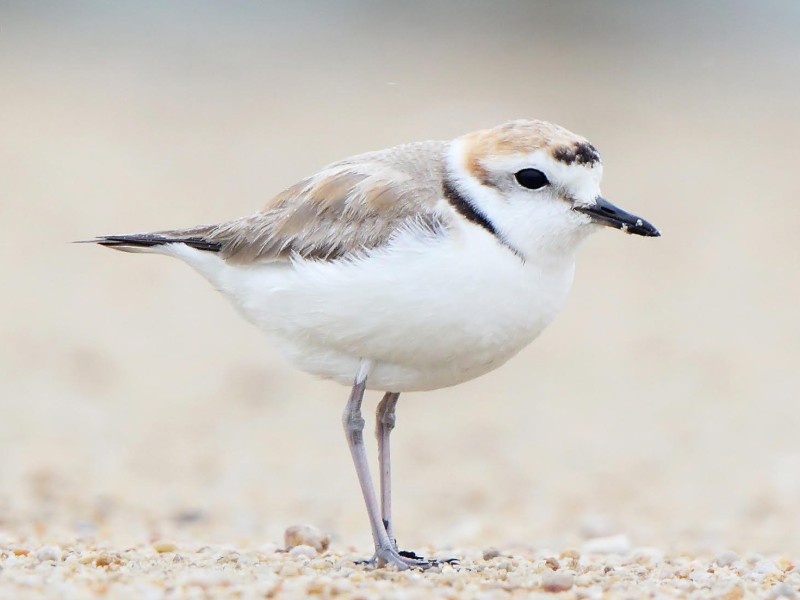
May 2014, Martin Hale. Male.
In breeding plumage it has a brighter orange crown than on Kentish Plover, and on the males the black loral stripe is much narrower or absent; the black frontal bar, however, is usually wider than that on Kentish Plover. The lateral breast patches are shorter and narrower on both male and female.
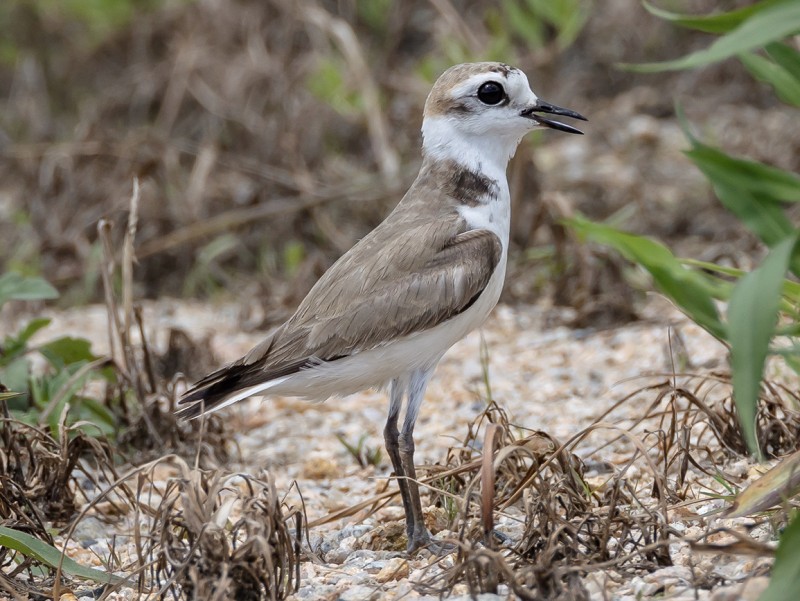
Jun. 2023, Matthew Kwan. Male.
This worn male at the end of the breeding season shows a much-reduced frontal band and barely any warmth on crown and nape. While the lateral breast patches are broad, they are short. The pale feather edges present in spring are lost.
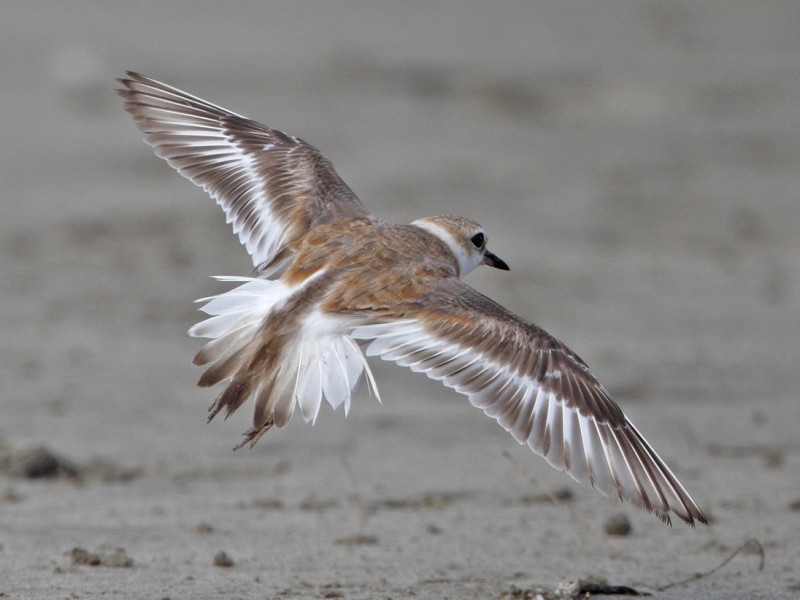
Jun. 2011, Guangdong, China. Martin Hale
The obvious broad white collar on the hind neck and, compared to Kentish Plover, the longer and broader white wing bar at the base of the flight feathers are visible on this bird.
VOCALISATIONS
The full range is uncertain but they appear to be similar to those of Kentish Plover.
DISTRIBUTION & HABITAT PREFERENCE
Most records have occurred on coastal mudflats but it has also been seen in a drained gei wai at Mai Po.
OCCURRENCE
Up to 2020 there had been eight records, all since 2013 with records occurring on 7 March, 4 May to 11 July, 26 August and 4 October to 30 January. One of these was a breeding record.
BREEDING
The first breeding record occurred in 2014 (Allcock and Hale 2016). After a pair were seen on 4 May, a nest with three eggs was noted the following day. On 18 May the female was accompanied by three chicks, which fledged in early June. They were last reported on 21 June. No further records of breeding occurred at the site despite it being checked in subsequent years. There were two further records of breeding at another site in 2023 and 2025.
BEHAVIOUR, FORAGING & DIET
No details but similar to Kentish Plover.
RANGE & SYSTEMATICS
Monotypic. The breeding range extends from Fujian along the southeast China coast to at least Hainan. It possibly breeds north to Zhejiang, Jiangsu or the west coast of South Korea. Most wintering records are from southeast Asian coasts from Vietnam to Sumatra, though there are also records in HK and Macau at this time (Limparungpatthanakij and Pyle 2023, Kennerley et al. 2008).
CONSERVATION STATUS
IUCN: Least Concern.
Allcock, J. A. and M. Hale (2016). Swinhoe’s Plover Charadrius alexandrinus dealbatus breeding in the New Territories. The first confirmed breeding record for Hong Kong. Hong Kong Bird Report 2014: 317-319.
Bakewell, D. N. and P. R. Kennerley (2008). Field characteristics and distribution of an overlooked Charadrius plover from South-East Asia. BirdingASIA 9: 46–57.
Kennerley, P. R., D. N. Bakewell and P. D. Round. (2008). Rediscovery of a long-lost Charadrius plover from South-east Asia. Forktail 24:63-79.
Limparungpatthanakij , W. L. and P. Pyle (2023). White-faced Plover (Anarhynchus dealbatus), version 2.1. In Birds of the World (B. K. Keeney, Editor). Cornell Lab of Ornithology, Ithaca, NY, USA. https://doi.org/10.2173/bow.whfplo2.02.1

