Mongolian Gull Larus mongolicus 蒙古銀鷗
Category I. Uncommon winter visitor and passage migrant to Inner Deep Bay and offshore areas.
IDENTIFICATION

Mar. 2021, Michelle and Peter Wong. Adult.
56-68 cm. Large gull, males larger than females. With the caveat that field separation of Vega and Mongolian Gulls cannot be confirmed objectively (Collinson et al. 2008), the following describes the features used in HK in winter to identify birds in HK. Structurally mongolicus is generally larger, deeper in the chest, longer-billed and longer-winged.
From November most adults have limited to barely any head streaking; if present, this is confined to the nape and sides of the neck. Compared to Vega Gull the upperparts are paler grey, the primaries have a larger extent of black and the legs are generally pinkish or peachy. Moult in adults is an important distinction as adult Mongolian Gull completes the replacement of primaries in early winter, usually no later than November. Consequently by the second half of the winter the white primary tips are usually noticeably worn; this is generally not the case in Vega Gull (primary moult complete December or January) or Lesser Black-backed Gull (complete end February or early March).
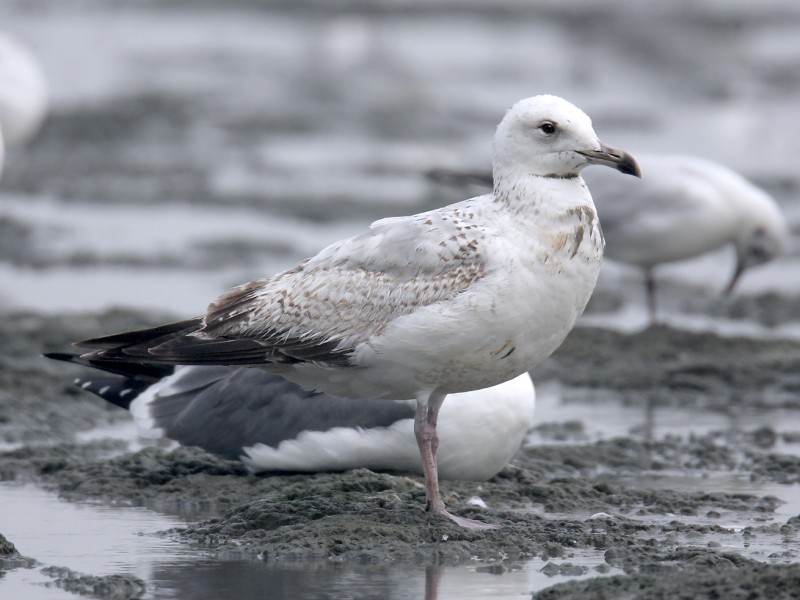
Mar. 2010, Michelle and Peter Wong. First-winter.
First-year mongolicus seen in HK are generally pale overall with dark brown primaries and tail tip and a black to black-tipped bill. Fading of the plumage occurs as winter progresses and birds may become very pale by mid to late winter. The have a rather white head and underparts with only pale brown mottling on the latter, pale grey or greyish-white mantle and scapular feathers usually with contrastingly dark streaks on the nape and clear-cut dark centres to some of the mantle and scapular feathers. The tertials and scapulars appear particularly prone to wear. The tail band is usually relatively narrow, and the inner primaries are obviously pale.
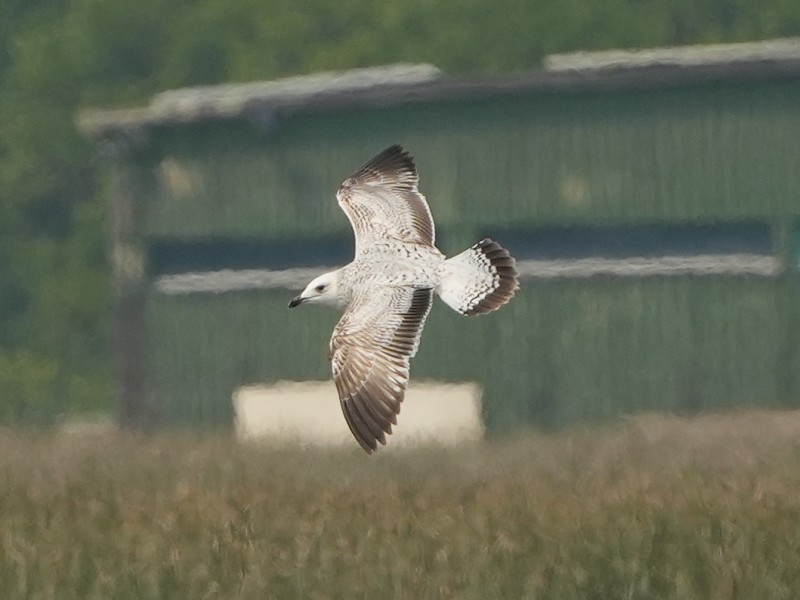
Feb. 2023, Roman Lo. First-winter.
First-winter birds in flight show paler inner primaries, a pale mantle and whitish uppertail coverts.
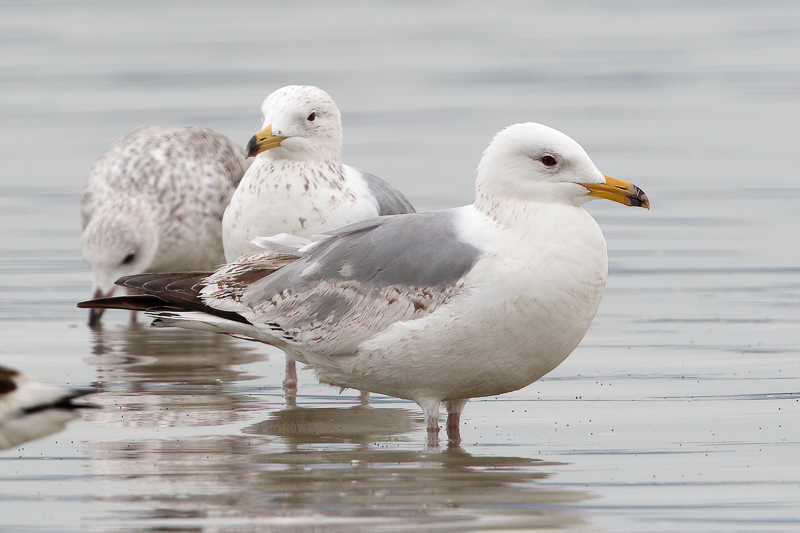
Mar. 2015, Martin Hale. Second-winter.
This second-winter bird has extensive grey in the mantle, scapulars and some wing coverts, a black-tipped yellowish bill, relatively clean white head and underparts and pale-fringed brownish tertials.
VOCALISATIONS
Non-breeding season calls are similar to those of other large gulls and do not appear to be useful for identification in HK.
DISTRIBUTION & HABITAT PREFERENCE
Most records of both taxa are from the late winter and early spring gull roost that forms on the falling tide in Inner Deep Bay near the Mai Po Boardwalk hides. Also seen in other intertidal parts of Deep Bay, including along the Kam Tin River, and on migration in southern waters.
OCCURRENCE
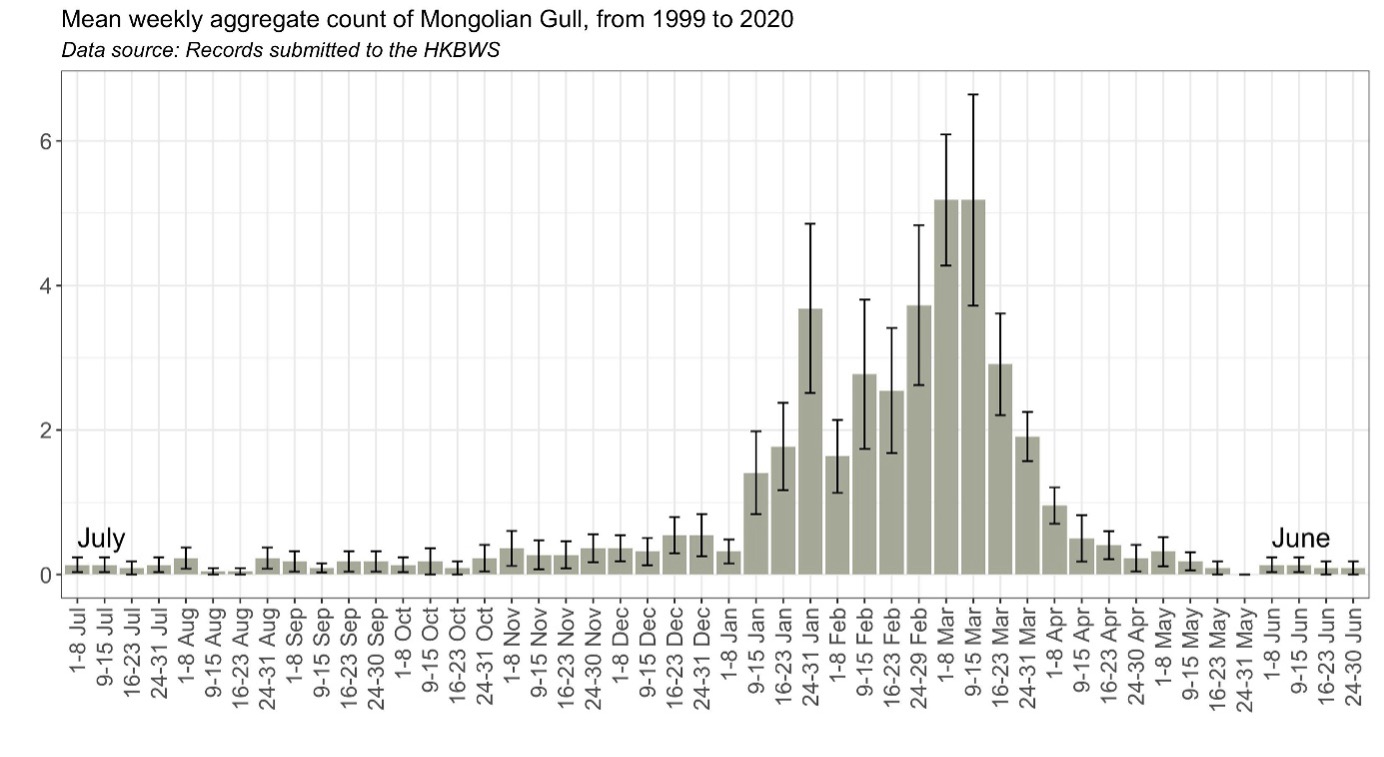
Mongolian Gull is a winter visitor and early spring passage migrant mainly from the second week of January to the end of March, with numbers peaking in the first half of March (Figure 1). Due to the paucity of high diurnal tides in November and December and the difficulty in observing large gulls at this time, it is possible that the numbers early winter are understated. Very small numbers occur less than annually at other times of year.
The highest count is 25 on 13 March 2000, comprising 13 first-years, two second-years and ten adults: such an age-class distribution appears to be broadly typical.
BEHAVIOUR, FORAGING & DIET
No information.
RANGE & SYSTEMATICS
Mongolian Gull breeds from the area around Lake Baikal from southeastern Altai to northwestern Mongolia east to northeastern China. It migrates southeast to winter in coastal eastern Asia from Japan to Hong Kong (Weseloh et al. 2024) and along inland waterways and large lakes in China, sometimes in very large aggregations. Vagrants south to Thailand and the Philippines are reported.
Taxonomy of the Larus argentatus group of large gulls is complex and not yet conclusively agreed. We follow AviList Core Team (2025) in treating this taxon as monotypic.
CONSERVATION STATUS
IUCN: Least Concern. Population trend stable (treated as Arctic Herring Gull Larus smithsonianus).
Figure 1.
AviList Core Team. 2025. AviList: The Global Avian Checklist, v2025. https://doi.org/10.2173/avilist.v2025
Collinson, J. M., D. T. Parkin, A. G. Knox, G. Sangster and L. Svensson (2008). Species boundaries in the Herring and Lesser Black-backed Gull complex. British Birds 101: 340-363.
Weseloh, D. V., C. E. Hebert, A. F. Poole, J. C. Ellis, P. Pyle, and M. A. Patten (2024). Mongolian Gull (Larus mongolicus), version 1.0. In Birds of the World (B. K. Keeney and S. M. Billerman, Editors). Cornell Lab of Ornithology, Ithaca, NY, USA. https://doi.org/10.2173/bow.casgul4.01

