Chinese Grey Shrike Lanius sphenocercus 楔尾伯勞
Category I. Accidental.
IDENTIFICATION

Nov. 2019, Kinni Ho.
Large, long-tailed grey shrike. The black facial mask extends over the lores, eye and ear coverts, while the white forehead and supercilium contrast with the grey crown. The rump and uppertail coverts are grey, while the tail is black with fairly broad white edges.
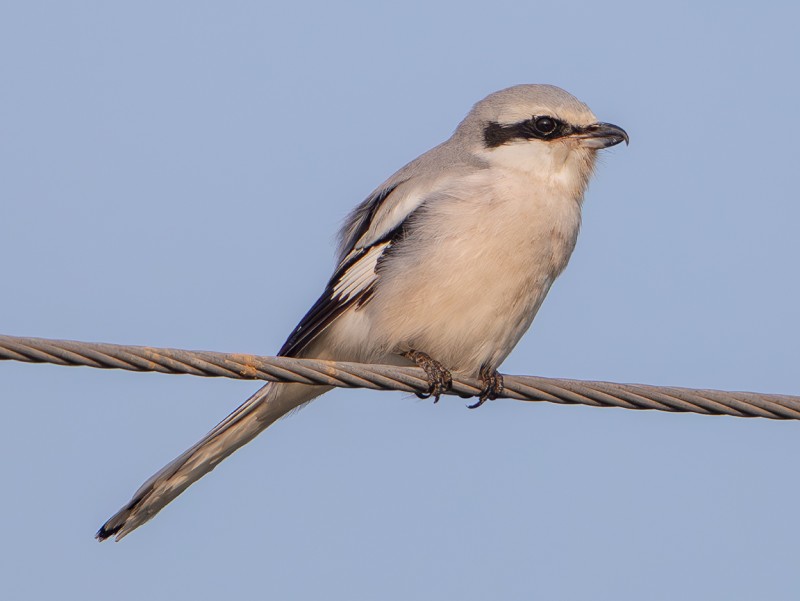
Nov. 2019, Michelle and Peter Wong.
The bill has a distinct hooked tip and a greyish base to the lower mandible.
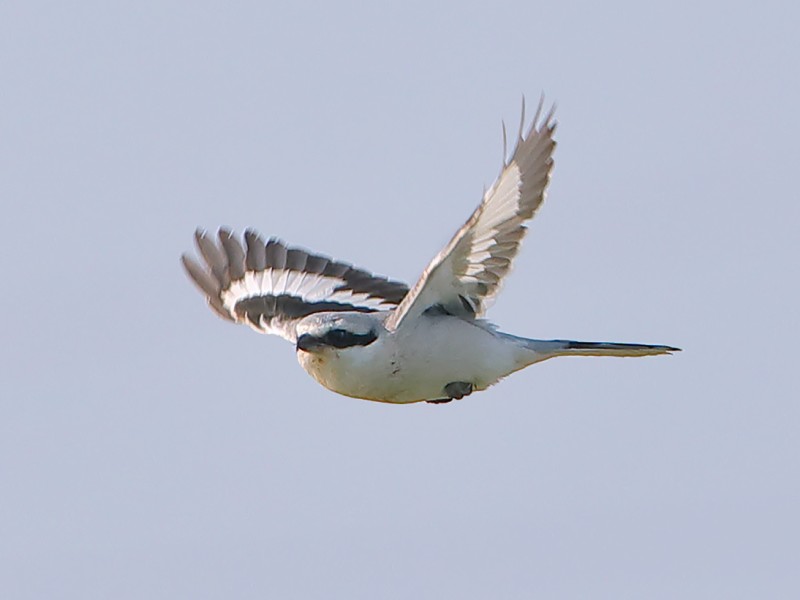
Nov. 2019, Michelle and Peter Wong.
In flight the broad white bases to the primaries and the long tail are visible.
VOCALISATIONS
Harsh screeches, often repeated appear to be most often heard.
DISTRIBUTION & HABITAT PREFERENCE
Recorded in open country, mainly the fish pond area at Tam Kon Chau but also at Mai Po NR.
OCCURRENCE
2019: one was at Tam Kon Chau and nearby areas from 5 November to 8 March 2020 (Ho 2023).
BEHAVIOUR, FORAGING & DIET
On 9 November it was seen in flight with a Scaly-breasted Munia in its bill.
RANGE & SYSTEMATICS
Monotypic. Breeds in eastern Mongolia and northeast China southwest to central north China (Yosef et al. 2021); winters south of there, though not generally as far as the coast (Liu and Chen 2021), where it appears to be rare.
CONSERVATION STATUS
IUCN: Least Concern.
Ho, Kinni (2023). Chinese Grey Shrike Lanius sphenocercus at Tam Kon Chau. The first Hong Kong record. Hong Kong Bird Report 2019: 242-244.
Liu, Y. and S. H. Chen (eds) (2021). The CNG Field Guide to the Birds of China (in Chinese). Hunan Science and Technology Publication House, Changsha.
Yosef, R., J. del Hoyo, N. Collar, ISWG International Shrike Working Group, G. M. Kirwan, and P. C. Rasmussen (2021). Chinese Gray Shrike (Lanius sphenocercus), version 1.1. In Birds of the World (S. M. Billerman and B. K. Keeney, Editors). Cornell Lab of Ornithology, Ithaca, NY, USA. https://doi.org/10.2173/bow.chgshr1.01.1

